

Why Your Next Business Venture Could Be On The Moon
In brief
- Artemis II signals a "lunar renaissance" focused on sustainable Moon exploration.
- Near-term opportunities are in digital infrastructure, not just long-term mining.
- SoftServe is building foundational robotics and simulation for future lunar missions.
Meet the expert

Lutz Richter
Space Projects Consultant
The Artemis II mission is more than just a flyby — it’s a historic return to the Moon, marking the first time humans have ventured beyond low Earth orbit in over 50 years. For millions alive today, this is their Apollo moment. Analysts call it the start of a “lunar renaissance,” as NASA’s crewed missions (and a growing wave of private sector investments) set the stage for sustainable Moon exploration. This mission signals a shift, where both governmental and commercial space activities refocus on the Moon after decades centered on the Space Shuttle program, and the Earth-orbiting International Space Station (ISS).

The next era of lunar exploration will depend on digital infrastructure, simulation, and autonomy as much as rockets and astronauts. The winners of this new space race won't just be aerospace giants, but also software companies that can solve complex computing and logistics challenges on the Moon. This in important distinction, because while many focus on long-term goals like moon-mining, the most immediate opportunities lie in building essential infrastructure (like positioning, navigation, timing (PNT), simulation, and autonomous robotics) to enable sustained lunar activity.
Learn more:
What trends are driving the lunar economy today?
The NASA-led Artemis program aims to create a sustainable human presence on the Moon, using it as a stepping stone for future Mars missions. Objectives:
- Moon mining: Upcoming missions will explore the extraction of lunar resources, such as oxygen and ice, to produce valuable consumables like rocket fuel.
- Industrial hub: Scientists will test if lunar soil can be turned into building materials. These materials would be easier to launch from the Moon due to its low gravity and could be used to build and fuel satellites.
- Lunar base: By using local resources for supplies and construction (a practice known as ISRU), we can reduce costs and dependence on Earth. This would allow humans to stay on the Moon for longer periods to advance space science.
What do most companies misunderstand about Artemis II?
What's being overlooked is that Artemis II is just a flyby mission, where four astronauts circle the Moon. The Artemis program still needs to finish developing a crewed lander, called the Human Landing System (HLS). SpaceX and Blue Origin are both working on different versions, but development is lagging, mostly due to underfunding over the years.
It wasn't until last year that NASA and its budget started prioritizing the HLS. This shift seems prompted by the concern that China's space program might beat the US to landing astronauts on the Moon for the first time since Apollo 17 in 1972. China has set a clear goal for a crewed landing before 2030, and their development of the necessary vehicles and rockets is already well underway.
How can companies prepare for lunar business opportunities?
Upcoming lunar missions will spotlight new space activities for the public and commercial sectors. While space commerce currently revolves around satellites, lunar progress will create new business models and opportunities. NASA’s Commercial Lunar Payload Services (CLPS) program already involves over 60 private companies and plans for about 15 lunar lander missions by 2028, showing strong industry engagement our clients can tap into.
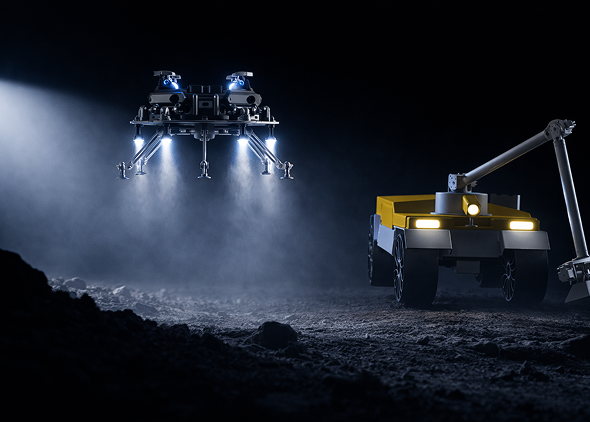
Multi-robot simulation
Multi-Robot on the Moon.Collaborative Exploration & Mining Simulation. Download
Another area of the emerging “lunar economy” (and possibly the one with the best near-term commercial promise) is PNT services, which stands for positioning, navigation, and timing. Lunar orbiting commercial assets will be in demand for relaying data and commands from and to surface landers, rovers, and outposts, especially in the polar regions and the farside, where Earth visibility is compromised or non-existent. Companies should explore partnerships to become early adopters of lunar commerce.
What are the biggest opportunities and risks in the lunar economy?
Where lunar space activities go, in situ resources exploitation is expected to drive business cases. But it's still too early to tell if mining on the Moon will actually be profitable. We just don't know enough yet about where the minerals and ice are located or how we'd even extract them. But every landing and roving mission on the surface adds certainty to our knowledge of lunar resources. On the regulatory front, momentum is building, and as of October 2025, 61 nations had signed the Artemis Accords.
The Artemis Accords are a U.S.–led, non‑binding set of international principles that establish rules of the road for peaceful, cooperative space exploration, starting with the Moon and extending to Mars and beyond.
How does SoftServe support the opportunities?
We're helping to lay the groundwork for humans to live on the Moon. We've partnered with Astroport on a NASA project, designing the architecture and robotics needed to prepare lunar sites for spacecraft landings and take-offs. We're also exploring how to set up a permanent base with interconnected modules. We’re looking at how thruster-propelled “lunar drones” can be used to map terrain at high resolution for resource exploration, and how mobile robots can collaborate in resource prospecting and mining.
As in other industries, SoftServe is a digital authority that leverages “simulation-first” and AI-powered automation approaches to help customers realize advanced, more robust and adaptable space systems, while shortening development, and validation and commissioning time, thereby lowering cost.
Learn more:
Start a conversation with usAbout SoftServe
SoftServe is digital engineering and technology services company. We expand the horizon of new technologies to solve today's complex business challenges and achieve meaningful outcomes for our clients. Our boundless curiosity drives us to explore and reimagine the art of the possible. Clients confidently rely on SoftServe to architect and execute mature and innovative capabilities, such as digital engineering, data and analytics, cloud, and AI/ML.
Our global reputation is gained from more than 30 years of experience delivering superior digital solutions at exceptional speed by top-tier engineering talent to enterprise industries, including high tech, financial services, healthcare, life sciences, retail, energy, and manufacturing. Visit our website, blog, LinkedIn, Facebook, and X (Twitter) pages for more information.
SoftServe Media Contact
Kayla Cash
Global Public Relations Manager
PR@softserveinc.com