


Outpacing the Competition: The OEM Advantage with Virtual Commissioning
 6 min read
In brief
- Virtual Commissioning is now a necessity for OEMs, enabling streamlined processes, faster timelines, and improved collaboration across teams.
- By identifying issues early, virtual commissioning reduces delays, cuts costs, and accelerates project timelines with 95% faster simulation times.
- Tools like virtual acceptance testing and operator training on digital twins give OEMs a significant edge in a rapidly evolving industry.
We are operating in a manufacturing environment that penalizes inefficiency more severely than ever before. For machine builders in the EMEA region, the pressure to maintain margins while delivering increasingly complex automated systems requires a fundamental reevaluation of how we bring products to market.
Traditional commissioning processes are no longer sufficient. In the face of structural challenges, simulation-based virtual commissioning has transitioned from an optional upgrade to an operational necessity.
Under Pressure: Why Today’s Machine Builders Face Greater Hurdles Than EverExternal economic and competitive pressures are compounding internal process bottlenecks. We face macroeconomic headwinds in the EMEA region. While the US anticipates equipment investment growth, the Eurozone is stagnating. Germany specifically is tracking toward a 14 percent decline in real equipment investment.
Meanwhile, upstart competitors are achieving annual cost reductions of 5 to 10 percent. In contrast, established OEMs typically target 1 to 2 percent improvements. When you combine this with rising labor, tax, and energy costs, the margin for error effectively disappears.
These external factors place pressure on the existing flaws in our traditional commissioning workflows:
- The Fault Chain Penalty: Defect resolution costs compound exponentially. A mechanical or software fault that takes one hour to fix in the design phase routinely takes a full day to remedy during assembly, and up to a week if discovered during site installation.
- Unsustainable Project Timelines: Complex machinery projects currently demand 10 to 14 months at the supplier facility, followed by an additional 3 to 6 months at the customer site for final acceptance.
- Physical Testing Constraints: Validating robotics and autonomous systems through physical prototyping is resource heavy. Physical tests simply cannot simulate the vast array of complex edge cases and system interactions required for modern machinery.
Unifying Expertise: Sharpening Collaboration Across Departments
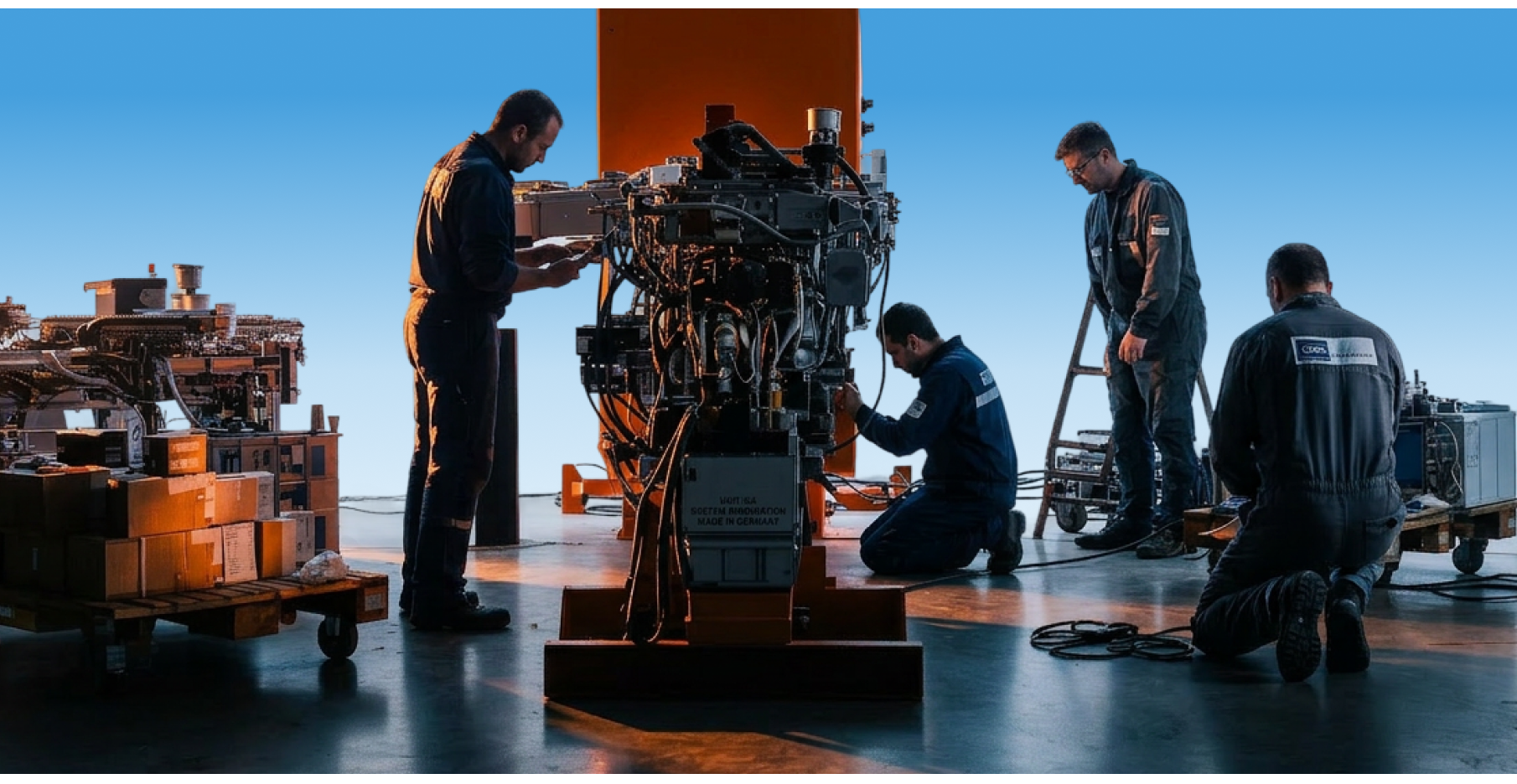
One of the most persistent operational hurdles in manufacturing is the linear, siloed workflow. Design engineering teams complete their specifications and "throw the grenade" over the wall to the commissioning team. Once the machine is built, it is handed off to manufacturing and operations. Each department optimizes for its own specific metrics, which leads to misalignment and extended ramp-up times.
Can Europe’s OEMs afford to rely on linear workflows when competitors are iterating in real-time? The answer is clearly no. Virtual commissioning forces a concurrent engineering model. It provides a single source of truth that breaks down these departmental silos through:
- Continuous Feedback Loops: Design, engineering, and operations teams collaborate in the same virtual environment, identifying integration issues weeks or months before physical assembly begins.
- Virtual Acceptance Testing: We can accelerate Factory Acceptance Testing (FAT) and Site Acceptance Testing (SAT) with virtual preparation. This limits the friction and delays on the customer's factory floor.
- Advanced Operator Training: Customers can train their operators on the digital twin while the physical machine is still being manufactured, drastically reducing the stabilization phase upon delivery.
Moving Beyond the Drawing Board: Harnessing the Digital Twin Advantage
Simulations are nothing new to OEMs. Yet current simulation limitations hinder both efficiency and accuracy. 30% of OEMs report that simulations take nine or more hours to complete, while 38% restrict model detail due to these constraints. Consequently, 52% admit to receiving low-fidelity results more than half the time.
Our approach to simulation-first commissioning involves simulating, testing, and validating machine performance in a high-fidelity digital environment before manufacturing a single physical component. By integrating high-performance computing and AI into our simulation tools, we can run thousands of operating scenarios in the time it takes to build one physical testbed. It operates as a functional application for a digital twin ecosystem.
Bottling Results: How Krones Accelerated Performance with Simulation-First Methods
The practical application of these concepts is evident in a recent project by Krones, a global leader in bottling and packaging technology. Krones required a method to optimize their highly complex filling machines, where even minor inefficient parameter settings could reduce output by thousands of bottles per hour. Legacy simulation processes were acting as a bottleneck, requiring up to four hours per run.
Krones integrated an AI-enhanced Digital Twin simulation to manage fluid dynamics and machine behavior. The engineering outcomes were significant:
- Simulation times dropped from hours to under five minutes—a reduction of 95%.
- The engineering team gained the agility to test multiple bottle designs and liquid characteristics at scale.
- Commissioning times were shortened, and overall line throughput was optimized prior to physical deployment.
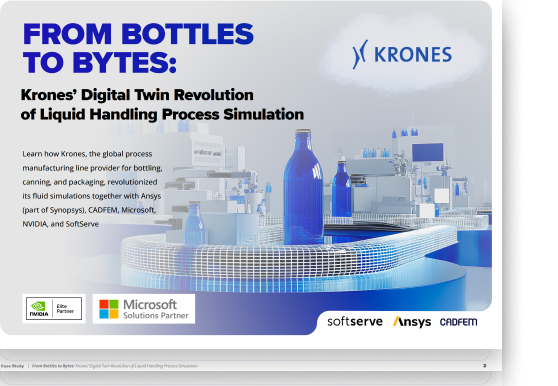
Krones case study — From Bottles to Bytes
How SoftServe reshaped a complex bottle-inspection process through high-fidelity simulation and digital twin innovation. DownloadThis implementation proves that transitioning to a simulation-first methodology directly impacts product viability and operational efficiency—and substantially reduces time-to-market.
Unlocking the Real-World Payoff of Digital Simulation
Our experience shows that the benefits of simulation and digital twin technologies for virtual commissioning are varied and profound:
- Faster Engineering Cycles: Accelerates product development and launch, cutting commissioning time by up to 50%.
- Risk Reduction: Digital validation catches issues early, reducing test operation costs by up to 30%.
- Multi-Scenario Efficiency: AI-powered tools allow rapid testing and optimization across many scenarios, increasing throughput by up to 20%.
- New Digital Offerings: Web-based platforms let clients engage with and optimize their systems digitally — driving greater customer engagement.
- Enterprise-wide Optimization: Digital twins scale across multiple sites, streamlining training and enabling standardized operations.
Adopting advanced simulation and digital twin technologies is not only about solving old problems—it's about fundamentally changing what’s possible in engineering and plant operations.
With deep engineering expertise and advanced AI‑driven simulation capabilities, SoftServe helps manufacturers move toward highly intelligent and sustainable factories.
Download the White Paper Learn the technical details of our approach, including architecture, workflows, and implementation.