


How Simulation And Digital Twins Lower Costs And Downtime For Manufacturers
 5 min read
Up to 50% faster commissioning and 90% quicker simulations
Manufacturers face a tough balancing act: deliver faster, keep costs down, and meet sustainability goals — without sacrificing quality. Physical trials slow progress and raise risk.
A better approach uses simulation, robotics, and AI-powered digital twins to validate designs, predict issues, and optimize processes before changes hit the shop floor — cutting commissioning time by 30%–50% and speeding simulations by 90%.
What problems do manufacturers face today?
Teams juggle speed, cost, quality, and sustainability. Traditional engineering relies on physical trials that introduce costly downtime. Data from the shop floor is underused, making decisions reactive. The result: longer commissioning, higher risk, and missed opportunities to improve throughput, energy use, and OEE. Manufacturing is complex, and the gap between what factories need and what legacy processes deliver is growing.
Modern manufacturing relies on a connected digital continuum that begins with simulation, extends into operational digital twins, and becomes fully actionable through virtual commissioning.

How do simulation and digital twins help?
Simulation and digital twins form the foundation. High-fidelity simulation lets engineers test layouts, workflows, and “what‑ifs” virtually — before touching the line. Digital twins connect those validated models to live data, creating a real‑time view of performance. Together, they reveal bottlenecks early, guide maintenance, and support energy optimization. This will reduce risk, waste, and time to value for engineering and operations teams.
What is virtual commissioning and why does it matter?
Virtual commissioning builds on this foundation. It tests PLC and automation logic in a safe, virtual environment before deployment. Engineers validate control behavior and edge cases without disrupting production. This approach cuts commissioning time by 30%–50%, minimizes shop‑floor risk, and supports smoother start‑ups and changeovers.
Together, simulation, digital twins, and virtual commissioning create a seamless digital thread that links design, automation, and operations, enabling faster scaleup, fewer risks, and more intelligent decision-making.
What technologies power simulation and digital twins?
SoftServe’s manufacturing solutions are powered by a modern ecosystem of simulation and data technologies, including:
- NVIDIA Omniverse™ and NVIDIA Isaac Sim™ for real-time, physics-accurate virtual environments
- High fidelity physics engines for modeling robots, materials, and fluids
- Cloud platforms (AWS, Google Cloud, Azure) for scalable computation
- IoT and integration layers that sync digital twins with live factory data
What business impact can you expect?
- Productivity and OEE Gains: Optimized layouts, smarter scheduling, and predictive maintenance boost throughput and reduce downtime.
- Faster Time-to-Market: Virtual validation shortens design cycles and cuts commissioning time by 30%–50%.
- Lower Operational Costs: Digital trials reduce physical prototyping and minimize rework.
- Greater Sustainability: Energy optimization and reduced waste align with environmental and regulatory goals.
- Improved Resilience: Digital tools enable rapid adaptation to fluctuations in demand, supply, or process conditions.
How does it impact each role?




Real-world example: How did Krones cut time and waste with a digital twin?
Krones, a global leader in bottling, canning, and packaging systems, needed a faster and more reliable way to understand how liquids behave during high-speed filling. Their fluid simulations took 3–4 hours, slowing engineering decisions and limiting their ability to optimize production lines. Krones needed a solution that could turn hours of waiting into minutes, and replace manual guesswork with confident, real-time insights.
Together with Ansys (Synopsys), CADFEM, Microsoft, NVIDIA, and SoftServe, Krones transformed this workflow with a high-accuracy, AI-powered digital twin of the filling process — a virtual environment that mirrors every drop, every turbulence, and every physical interaction inside a real bottling line.
This solution was introduced:
- A high-fidelity digital twin that accurately simulates liquid behavior in real filling machines
- Advanced physics simulation via Ansys Fluent
- GPU-accelerated computation and visualization with NVIDIA technologies
- Cloud scalability and orchestration using Azure AKS
- A single, intuitive interface for testing and scenario exploration
The transformation was immediate and measurable:
- >90% faster simulations (reduced from 3–4 hours to ~30 minutes), enabling rapid iteration and faster engineering decisions
- Lower waste and resource use through accurate, real-time scenario testing
- A centralized, intuitive dashboard that provides actionable insights and acts as a second, continuously improving version of the production line
For Krones, it became a second version of their production line, one that continuously learns, predicts, and improves.
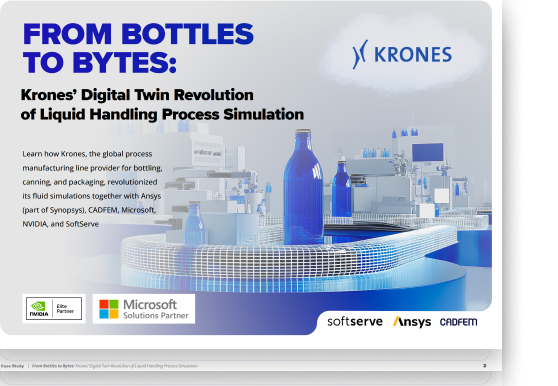
Krones case study — From Bottles to Bytes
How SoftServe reshaped a complex bottle-inspection process through high-fidelity simulation and digital twin innovation. DownloadHow do we get started — without risking the line?
- Select a high‑value use case (e.g., changeover or filling stage)
- Build a simulation and validate against current performance
- Connect live data to create the digital twin
- Run virtual commissioning and track metrics (time, waste, OEE)
- Document wins; expand to the next area
With deep engineering expertise and advanced AI‑driven simulation capabilities, SoftServe helps manufacturers move toward highly intelligent and sustainable factories.
Start a conversation with us