


Overcoming Physical Constraints: Solving the Data Scarcity Problem for Visual AI With Synthetic Data
 9 min read
In brief
- Real-world data scarcity significantly challenges the development and deployment of visual AI models in robotics.
- Synthetic data and digital twins enable scalable model training for rapid iteration, simulation of edge cases, and enhanced safety validation.
- SoftServe and Wandelbots leverage NVIDIA technologies and innovative platforms to accelerate vision AI and automation for flexible, future-ready robotics.
Discover how synthetic data is driving a new approach to robotics with visual AI — using Wandelbots NOVA, NVIDIA hardware, and SoftServe know-how
We are witnessing an inflection point where the constraints of legacy automation are giving way to the promise of sensor-rich, truly intelligent robotic systems. The field is no longer limited by rigid, hard-coded behaviors; our collective focus has shifted to adaptive architectures, powered by state-of-the-art vision AI and capable of rapid iteration across manufacturing environments. Yet, a persistent bottleneck remains: acquiring robust, high-diversity datasets for task-specific model development. Can we realistically meet the data requirements for reliable perception at scale using only real-world samples? Our experience suggests otherwise.
Imagine a deployment involving innovation in flexible autonomous assembly, in which cell reconfiguration and variance in part geometry are everyday realities. Expecting a vision model to generalize across the full range of permutations — lighting shifts, part contamination, manufacturing tolerances — is unrealistic without a digital-first paradigm.
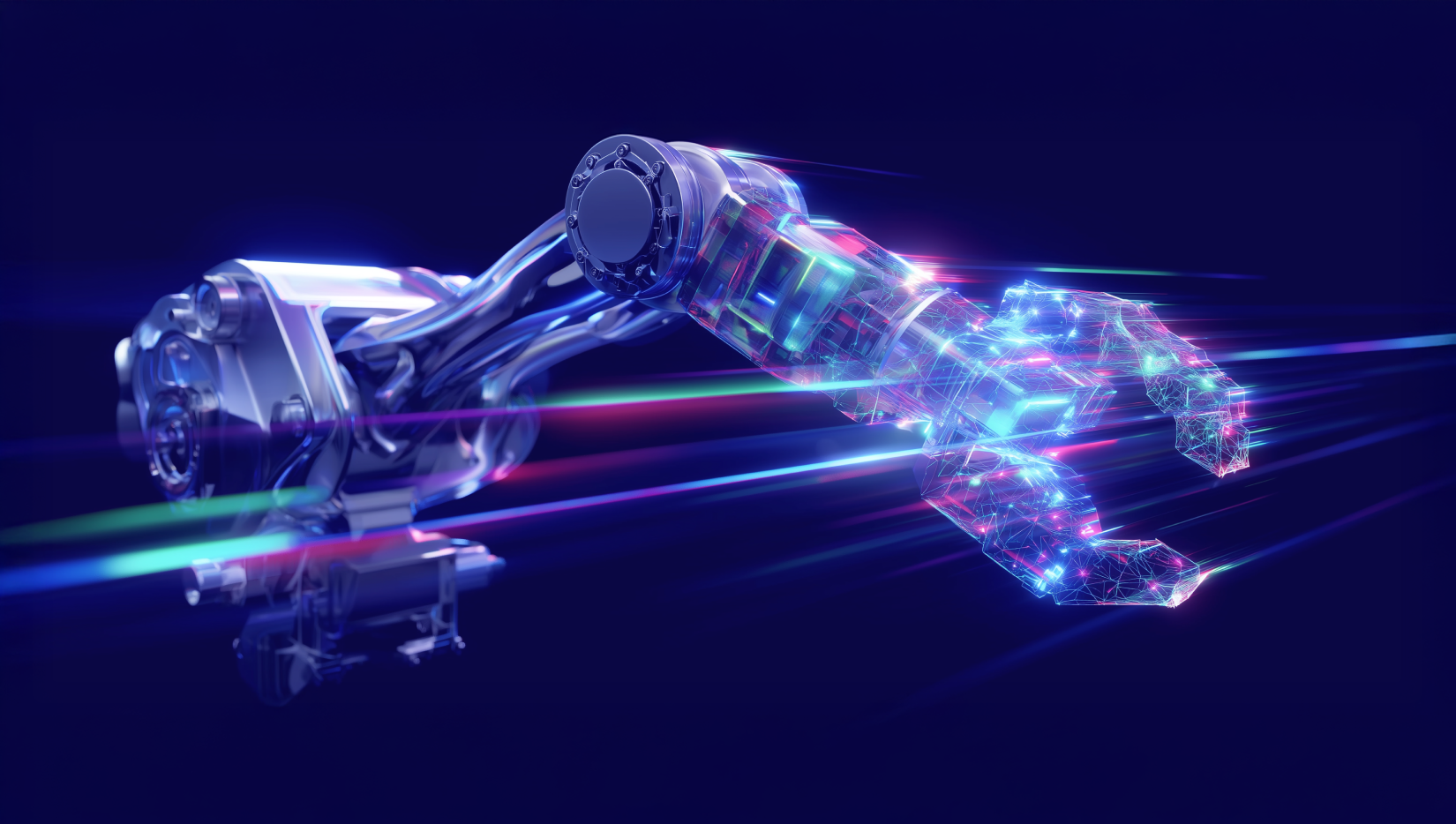
That is why the emergence of high-fidelity digital twins and generative synthetic data is reshaping how we approach vision system training and deployment. This article will explore how Wandelbots and SoftServe are harnessing NVIDIA technology to drive advancements in this space — redefining traditional approaches. Read on to learn more about the role of digital twins and synthetic data in enabling robust, scalable vision system solutions.
Being Realistic About Real-World Data: The Linchpin for Robust Vision Models
Real-world manufacturing is a dynamic theater. As such, modern industrial automation requires systems that can adapt to dynamic environments. This flexibility depends on cameras and sensors that feed data to intelligent software, which in turn controls the machinery. A key component of this intelligence is task-specific AI vision models to identify and analyze specific parts or areas within the raw data from sensors.
Consider a flexible robotic solution designed to handle screws. The system must not only detect the screw but also analyze its properties — like color, pose, and condition — for applications ranging from handling to quality inspection. Training an AI model to perform this task reliably requires a vast and diverse dataset, including images of the screw under countless conditions: different lighting, poses, and material states like dirt, dust, or wear. Indeed, the highest-performing vision models are those trained not just on canonical part images but also on edge cases — the “unknown unknowns.”
Capturing this data in the real world is impractical or impossible. New products typically exist only as digital assets during the engineering phase, making physical data collection impossible. This is where high-quality digital twin visuals and synthetic data become indispensable. With well-instrumented digital twins, we provision data for any conceivable scenario — new part variants, rapid retooling, and evolving safety envelopes as human workflows change alongside robot cells. Physical constraints are merely another parameter.
Overcoming the Limitations of Real Data
Synthetic data offers a powerful solution to the data scarcity problem that plagues AI development in robotics. Instead of relying on physical prototypes and time-consuming photoshoots, developers can create ultra-realistic, photorealistic renderings of product parts and automation cells within a simulated environment.
Indeed, the real world is inherently messy. Access to factory floor data is limited by equipment downtime, production launches, and human-induced annotation bias. Rare failure events, by definition, seldom occur. This is where synthetic data becomes transformative.
By connecting our digital twins directly to control stacks, you can simulate full automation cycles and output thousands of perfectly labeled images per hour. Suppose we need to explore sensitivity to reflective coatings or model insufficient part ejection; parametric simulations can be run, error states injected, and targeted datasets auto-generated for those precise scenarios — all modeled from CAD data and process specifications.
With a digital twin enriched with synthetic data, we can generate large volumes of perfectly labeled images while systematically randomizing conditions like object poses, textures, and lighting. This process ensures the training data covers the full spectrum of potential real-world scenarios — overcoming bottlenecks and accelerating development.
Flexible Automation and Agile Response
Speaking of acceleration: the flexibility of automation is limited if every change request triggers weeks of downtime. In conventional workflows, any change means retooling and a scramble to collect and annotate new images. With a simulation-first approach, that cycle is upended: the digital twin becomes the source of truth, and synthetic datasets can be produced on demand.
A simulation-first, synthetic data-driven approach offers a more agile solution. Consider a scenario in a hypothetical greenfield assembly facility. If a minor supplier change in screw finish leads to detection failures, instead of embarking on a complex root-cause investigation on the physical line, one could feed the updated visual signature into the digital twin, regenerate synthetic datasets, retrain the model, and validate the solution in simulation — all within 48 hours — without interrupting production.

The model is then retrained and validated in simulation before being redeployed, all without disrupting the physical production line. This workflow is made efficient by tightly coupling control and simulation, which allows the same control logic to run in both simulated and real environments.
Functional Safety and Synthetic Data: Closing the Loop
Safety in advanced robotics requires more than field testing and best guesses. Near-miss events, human-in-the-loop situations, and sporadic part jams are inherently high-risk and not easily orchestrated in production. Today’s digital twin environments let us script catastrophic scenarios and validate model behaviors and failsafes thoroughly before going live.
In a safety certification project, it’s conceivable that regulators would accept synthetic worst-case datasets generated from digital twin incidents as part of validation documentation. While this approach cannot replace live validation, it can augment it — enabling rapid capture of critical edge risk signatures at scale.
Overcoming the Limitations of Real Data
It is important to state the obvious: no digital twin achieves perfect fidelity. Domain adaptation remains critical; real-world nuances — lens artifacts, unexpected contamination, human interactions — must feed back into the model development process. The hybrid workflow we advocate is increasingly becoming standard across advanced robotics teams and consists of the following stages:




The goal of our approach is not to eliminate the need for real-world data but to strategically reduce dependency on it by making its use more targeted and efficient. This approach allows real-world data to focus on addressing specific limitations or confirming performance under actual operating conditions, significantly streamlining the data pipeline while ensuring robust and reliable outcomes.
The Partnership Behind the Revolution
Leveraging strategic partnerships is essential to advancing the development and adoption of cutting-edge technologies. These partnerships also facilitate the sharing of critical data and insights, which are foundational to building scalable and robust technological stacks. Ultimately, such alliances are instrumental in creating a cohesive ecosystem that propels industry-wide progress.
Wandelbots and SoftServe are proud to represent one such partnership, bringing complementary and unique offerings to complex projects in flexible robotics. By leveraging state-of-the-art technology, including NVIDIA Omniverse™ and NVIDIA Isaac Sim™, we are changing the way clients develop flexible automation solutions:
- Wandelbots NOVA is a software defined robotics platform that unifies programming, simulation, and control, integrated with NVIDIA Isaac Sim and Omniverse for continuous virtual-to-real deployment.
- SoftServe brings deep AI engineering, digital twin, and robotics credentials, ensuring that synthetic realism, data management, and cloud-based orchestration are delivered seamlessly across global deployments.
Together, our teams can launch engagements with digital twin development and synthetic pipeline validation, iterating through simulation until automation proves robust and reliable. Physical rollout need not be the primary bottleneck, but rather, the final precision-tuning step.
Where Do We Go From Here?
Are you already leveraging digital twin and synthetic data capabilities to their full extent, or are old silos holding you back? The convergence of simulation, synthetic data, and real-world calibration is not just possible but increasingly essential. The teams that adopt a simulation-first AI lifecycle for operationalizing advanced robotics systems that improve efficiency and resilience within industrial environments will set the benchmark for automation reliability, modularity, and safety.

Accelerate outcomes despite data shortages
SoftServe leverages NVIDIA technology to solve challenges with synthetic data. Learn moreIs your team ready for a paradigm shift? What breakthroughs or barriers are you facing as you implement hybrid data workflows, adapt to new production realities, or inject innovation into established lines? Wandelbots and SoftServe together empower manufacturers to accelerate automation deployment, cut development time, and maintain control over critical IP — all while enabling more agile, flexible production environments. Let’s exchange experiences, debate best practices, and set new standards for what’s possible in industrial robotics.
Start a conversation with us