


 5 min read
In brief
- Agentic AI is driving measurable performance gains across sectors as structured workflows shift from manual execution to automated sequences.
- Organizations report shorter turnaround times, higher productivity, and reduced operational pressure as multi step tasks move to agent driven processes.
- Economic considerations are growing as reasoning models require more compute and repeated model calls increase cost variability.
- Successful adoption depends on clear governance, infrastructure decisions, and realistic modeling of long term operational expenses.
A shift already measured in hard numbers
Agentic AI is reshaping enterprise performance in ways that are no longer theoretical
A familiar tension was growing inside a retail bank’s risk division. Analysts were losing hours to manual data gathering and memo assembly. When the team introduced an agent‑driven workflow to take over early data extraction and synthesis, turnaround time fell by 30% and analyst productivity rose by 60%. The change gave specialists room to focus on judgment, not assembly, and relieved a pressure that had built up for years.
Similar patterns are emerging far beyond financial services. Healthcare teams, customer support operations, engineering groups, and retail organizations all face repetitive, multi‑step tasks that slow decision cycles and consume skilled time. As agentic systems absorb these structured workflows, sectors across the economy are seeing new operational balance, steadier workloads, and cost patterns that reflect a more efficient division of effort between people and automated reasoning.
Moving toward autonomous workflows
Agentic systems introduce value that traditional automation could not reach. These systems:



These value streams are compelling because they expand beyond efficiency improvements and move into areas that once required extensive expert labor.
Organizations in software engineering, healthcare, financial services, and retail report clear productivity gains from early deployments. In software development, about one third of pull requests on GitHub come from bots, showing how automated agents now handle a meaningful share of routine contribution. In healthcare, The Permanente Medical Group logged 2.58 million AI‑scribe uses and saved an estimated 15,791 documentation hours in one year, easing administrative load and improving visit. In banking, JPMorgan’s consumer unit reported nearly a 30% reduction in servicing costs as AI absorbed routine call‑center and back‑office work, based on data shared during the firm’s 2025 Investor Day. In retail service operations, analysts project agentic systems will autonomously resolve up to 80% of common support issues by 2029, with operational costs reduced by roughly 30%, indicating how rapid‑response agents can take over the bulk of customer requests.

These outcomes indicate a tectonic shift in how work gets done. Leaders are prioritizing systems that carry full operational sequences such as data gathering, summarization, handoffs, and follow‑ups, rather than tools that assist with isolated steps. Retailers see this in growing AI‑assisted shopping journeys, with 30% to 45% of US consumers using generative AI for product research and comparison, a sign that agentic flows will extend from service into discovery and purchase decisions.
Economic pressures associated with agentic AI
Although the gains are meaningful, the economics behind agentic systems demand careful planning. Reasoning models require far more compute, with some systems consuming up to sixteen times the resources of earlier AI techniques. Multi‑step workflows call the model repeatedly, which increases total resource consumption and amplifies cost variability. Infrastructure decisions influence long‑term financial commitments. Some organizations explore dedicated in‑house environments, while others rely on external providers that absorb training costs and offer consumption‑based access.
Training advanced models remains expensive, and major technology companies continue to shoulder most of this burden. This dynamic allows enterprises to adopt agentic capabilities without funding the full training lifecycle. Even so, hidden operational costs cannot be ignored. Governance, compliance, workforce readiness, and integration strategy all influence the total cost of ownership.
Adoption is not automatic. Data silos, legacy systems, unclear governance, and readiness gaps often limit progress. Many organizations launch pilots that never reach production due to misalignment, resource constraints, or escalating costs. These challenges show why structured planning and accurate economic modeling are essential. Leaders must understand not only what agentic AI can accomplish, but what it costs to operate at scale and how it fits into the broader technology environment.
Take an informed approach
Agentic AI offers measurable opportunity, but capturing that value requires more than enthusiasm. Organizations must evaluate architecture patterns, infrastructure commitments, governance frameworks, and the long‑term economics of autonomy. Those that pair technical capability with planning discipline see the strongest outcomes. They enter the shift with clarity about both the upside and the complexity.
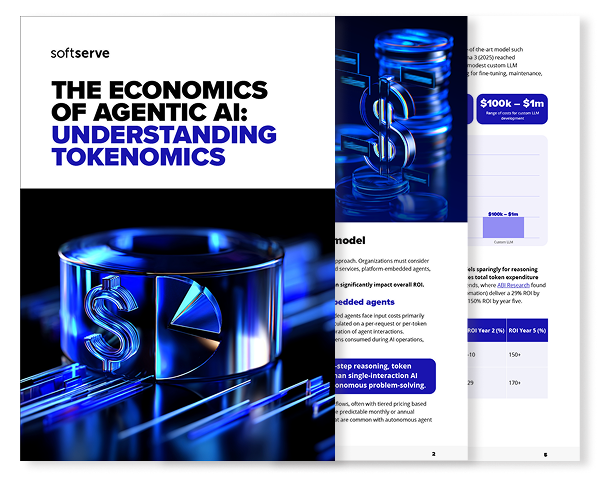
Read our Economics of Agentic AI report
Get to know the cost dynamics, value streams, and strategic considerations behind multi‑agent systems. READ HEREThis is just the introduction to a larger economic story. The next sections walk through the patterns behind rising token consumption and show how different workflow designs change computational load. They also outline practical steps for managing cost trajectories as agentic systems scale, including workload routing choices, model selection strategies, integration planning, and approaches for reducing operational drift. Read part two and part three for a clearer view of where the real expenses sit, how to measure value as usage grows, and what levers you can use to keep performance and cost in balance.
Start a conversation with us