


 6 min read
Selling today is more complex than ever. Products evolve quickly, pricing models shift, and customers expect accurate quotes within minutes, even when deals involve multiple products, regions, or service combinations. At the same time, sales teams lose hours to manual tasks that slow the sales cycle and create inconsistencies.
CPQ (Configure-Price-Quote) changes the process. By standardizing how offerings are configured, priced, and quoted, CPQ reduces errors, accelerates approvals, and gives sales reps more time to focus on actual selling. This article looks at how Salesforce CPQ works, the pain points it addresses, and where it delivers the most value.
WHAT SALESFORCE CPQ IS AND HOW IT WORKS
Salesforce CPQ helps companies manage complex sales by consolidating product, pricing, customer, and partner information into a single system. Instead of relying on manual spreadsheets or disconnected tools, sales teams move through guided workflows that recommend the right products, apply pricing and discount rules, and produce accurate quotes.
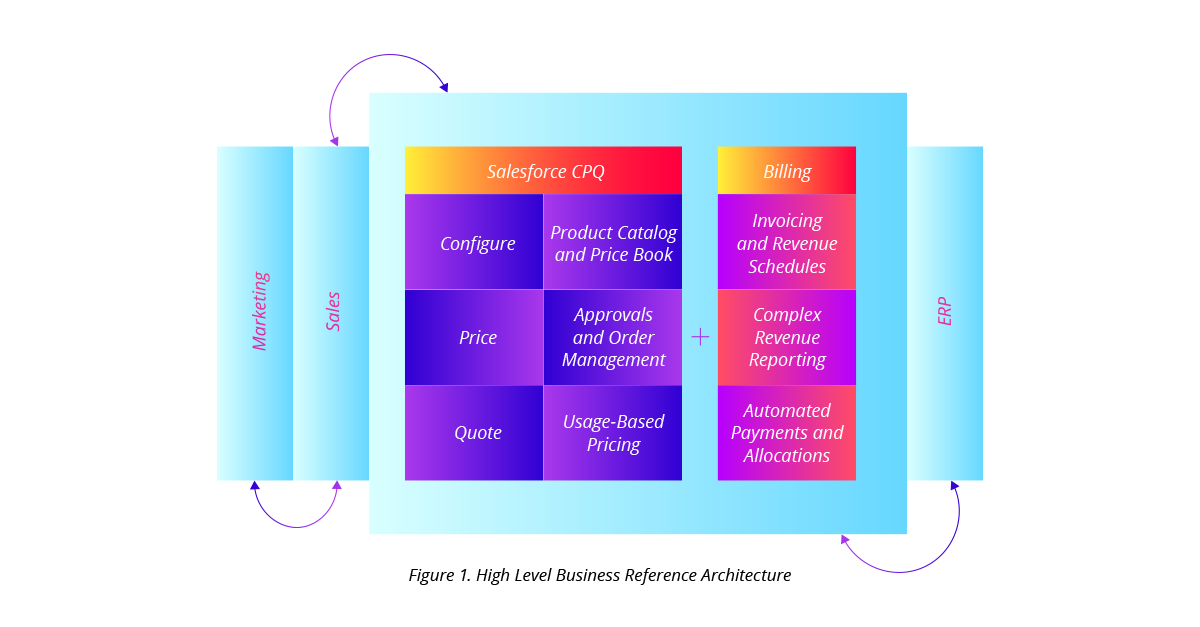
The platform automates approval steps, manages contracts and renewals, and integrates with ERP and CRM systems for complete visibility. As the sales cycle shifts from one stage to another, CPQ keeps product logic, pricing, and customer data aligned.
Salesforce CPQ capabilities include:
- Guided selling to recommend the right offerings
- Pricing and discounting rules with margin controls
- Dynamic configuration that prevents incompatible combinations
- Automated quote generation
- Approval workflows
- Contract lifecycle management
- Support for product bundles and modular selling
- Renewals and subscription management
- Reporting and dashboards
- Integration with ERP and CRM
- Custom development options for unique requirements
Together, these capabilities give companies a standardized, predictable, scalable way to handle quoting, even when the process spans multiple teams, systems, and regions.
COMMON PAIN POINTS IN COMPLEX SALES AND CPQ PROCESSES
Many challenges appear long before a CPQ system is introduced and continue if CPQ is not configured or adopted properly. These issues slow teams down and create friction across the sales process.
1. Long sales cycles and operational bottlenecks
Sales reps spend nearly two-thirds of their time writing proposals and generating quotes instead of engaging customers. This manual work leads to inconsistent pricing, slow turnaround, and more back-and-forth during negotiations. The more complex the deal, the more time disappears into spreadsheets and approvals.
2. Growing product and pricing complexity
As portfolios expand, salespeople must account for product rules, competitor pricing, geographic constraints, discount structures, and more. Without a structured system, quoting becomes an internal puzzle instead of a customer-focused conversation. Complexity isn’t the problem; lack of clarity is. When product and pricing logic live in spreadsheets or tribal knowledge, accuracy becomes hard to maintain.
3. Difficulty supporting recurring revenue models
Subscription and usage-based pricing introduce new operational challenges:
- maintaining data continuity
- tracking renewals
- scaling pricing updates
- forecasting recurring revenue
Legacy systems often can’t adapt quickly. A simple pricing change may require custom code or manual workarounds, turning small adjustments into long tasks. For companies with growing subscription portfolios, this creates friction across sales, finance, and support.
4. Complicated integrations with other business systems
Most organizations rely on multiple applications across sales, finance, operations, and customer support. To get the full value from Salesforce CPQ, the platform must connect seamlessly with ERP, CRM, billing, and other tools. While Salesforce integrations follow established patterns, each project requires planning, strategy, and careful execution. Without proper integration, data inconsistencies and process gaps appear quickly.
WHAT SALESFORCE CPQ ENABLES
Salesforce CPQ gives companies the structure and flexibility they need to price, configure, and quote complex deals without slowing down sales teams. It supports different margin strategies, discount levels, and product structures, allowing teams to build accurate proposals across diverse product lines or regions.
Speed is essential in today’s market, and CPQ helps teams produce even the most complex proposals quickly by replacing manual work with guided configuration and automated pricing rules. Organizations often see measurable improvements, for example, Dexter + Chaney achieved a 30% increase in quote accuracy after implementation.
CPQ also supports modular and bundled selling, ensuring incompatible combinations are avoided and pricing remains compliant. Dynamic configuration keeps the quoting process focused and intuitive, helping reps guide conversations clearly and confidently.
For companies running recurring revenue models, CPQ offers unified customer visibility, automated renewals management, and accurate forecasting. With 68% of companies earning at least 20% of their revenue from subscriptions, streamlined renewals and pricing flexibility directly influence ARR and churn. CPQ allows teams to introduce new pricing models or updates without relying on legacy workarounds.
By centralizing product, pricing, and customer data, Salesforce CPQ supports long-term growth and provides every team a consistent view of customer relationships.
HOW SOFTSERVE DELIVERS CPQ SUCCESS
1. Understanding the business context
Every CPQ project starts with understanding the “why.” We look at your sales model, product structure, approval steps, and current bottlenecks. This helps make sure the solution supports your goals rather than simply replicating old processes in a new tool.
2. Building the solution vision
Together with stakeholders, we outline what the CPQ solution should achieve, what problems it solves, what capabilities it needs, and how success will be measured. Some clients need help shaping this vision; others arrive with answers and move directly into detailed design.
3. Designing the solution
Our consulting and architecture teams translate the solution vision into a clear, technical design. For CPQ, this includes mapping configuration rules, pricing logic, quoting workflows, discount structures, product bundles, and required integrations.
4. Building and implementing the solution
Implementation happens iteratively, especially when multiple integrations or legacy systems are involved. We connect CPQ with billing, ERP, and other systems, automate workflows, and handle the logic behind more complex pricing scenarios. Stakeholders test the solution throughout the process to ensure it behaves as expected.
5. Ensuring long-term value
After go-live, we support adoption, training, and enhancements. The Hyper Care phase helps teams get comfortable with the tool and ensures the solution continues to perform as your pricing strategy or product catalog evolves.
CONCLUSION
Companies continue to face increasing complexity in the way they sell, price, and package their products. CPQ solutions help streamline the entire opportunity-to-quote-to-order process, making it easier for sales teams to work accurately and efficiently.
Organizations that adopt Salesforce CPQ often see meaningful improvements, for example, Politico reported a 17% revenue contribution increase, and Mitsubishi achieved a 50% ROI improvement in quote-to-cash operations.
If you’re exploring how to improve your sales operations or accelerate your quoting process, SoftServe can support your next steps.
Start a conversation with us